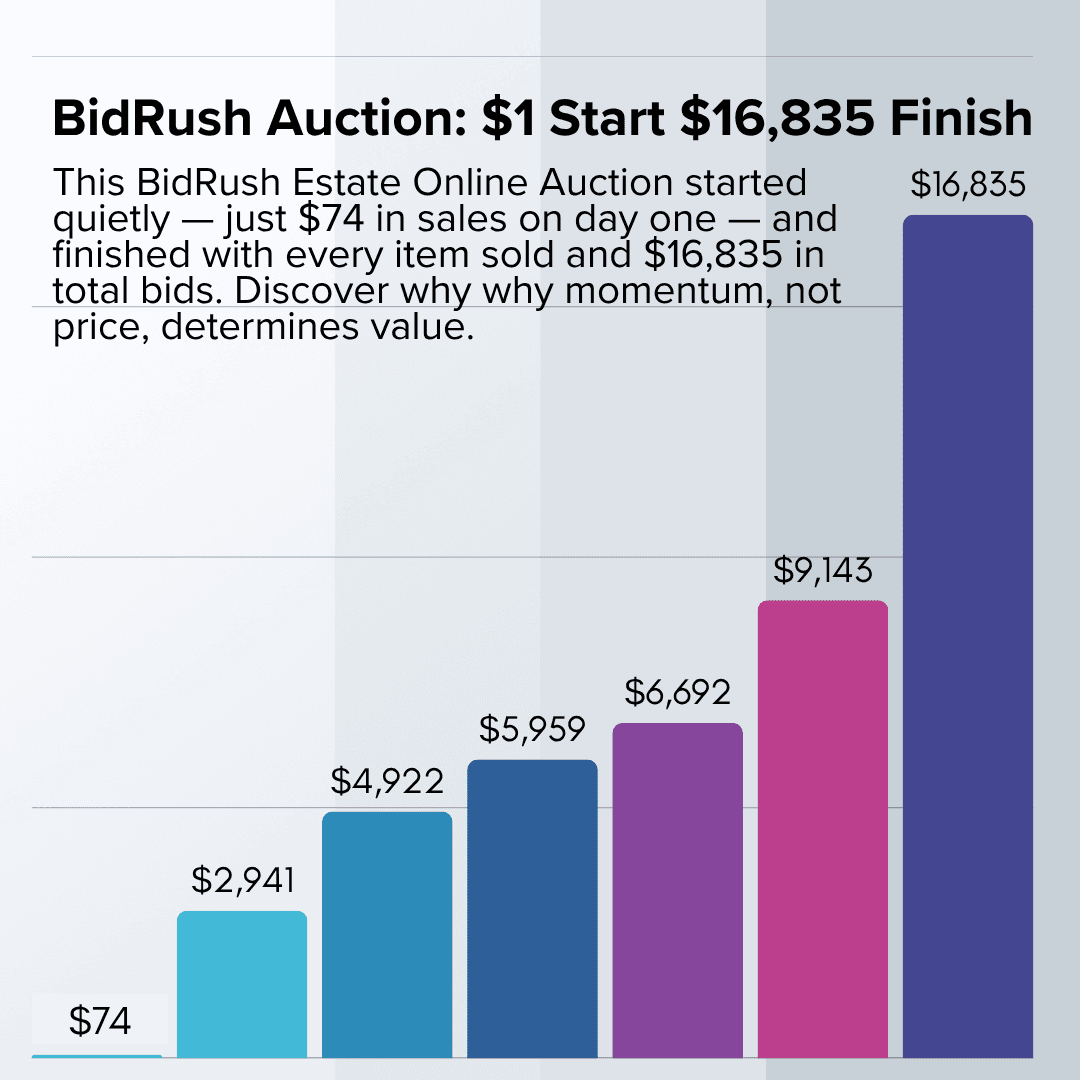
BidRush's first full inaugural auction proved something simple: a successful new-market launch does not require thousands of bidders.
It requires the right bidders. It also requires the right inventory as demand cannot be manufactured for items buyers simply aren’t looking for. Successful auctions happen when qualified bidders compete over desirable merchandise.
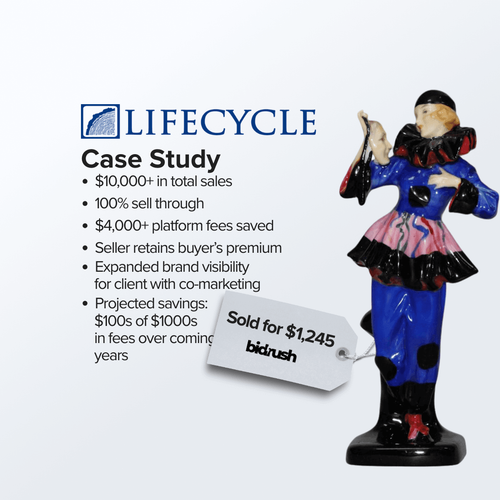
When LifecyclePro Estate Services launched the Carlisle Estate Sale on BidRush, the auction started with zero bidders and zero bids. The first bid came 13 minutes later.
One week later, auction Q73PNW closed at $10,345 USD ($14,690 CAD) with 96 unique bidders, 141 out of 141 lots sold, and a 100% sell-through rate.
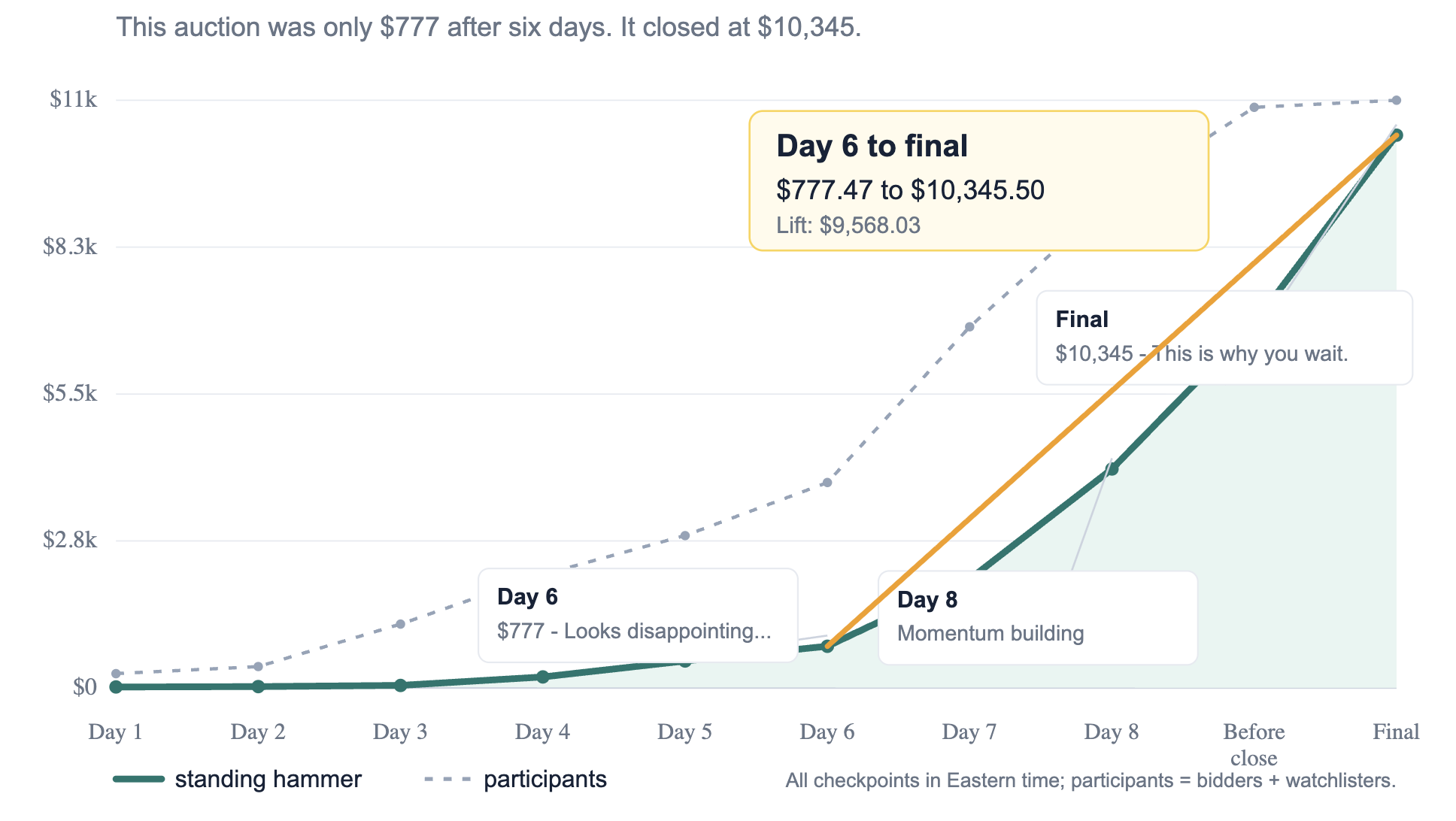
That is the point of these results. BidRush did not need tens of thousands of bidders to launch a new market. In its inaugural auction in the region, fewer than 100 bidders created a five-figure result.
The Launch
It was BidRush's inaugural auction in Massachusetts and an important test for new market launches. Could BidRush bring enough buyer demand into a new local market to support a professional estate sale? Could fewer than 100 bidders produce a meaningful client result? Could the platform convert collector interest into real bidding without depending on massive audience numbers?
The answer was yes.
By the end of the sale, the auction had generated:
Total hammer $10,345 USD ($14,690 CAD)
Lots sold 141 / 141
Sell-through 100%
Total bids 2,521
Unique bidders 96
Unique buyers 40
This is the useful benchmark for sellers choosing to use BidRush in a new area. The auction did not need 1,000 bidders. It did not need a mature local marketplace built over years. It needed a focused pool of qualified buyers who were willing to compete.
The Royal Doulton Moment
The top lot showed how that competition played out.
Royal Doulton Figurine – The Mask closed at $1,245 after 72 bids. The final two bidders traded the lot up from approximately $751 to the final $1,245 hammer.
[ See auction results ] Other standout results included:
Royal Doulton Figurine – The Mask $1,245
Royal Doulton Figurine – Butterfly $645
C.A. Briggs Company Salesman's Samples (1957) $360
Gold & Onyx Knights Templar Pendant $350
Royal Doulton Bunnykins – Holidays $245
The Like-for-Like Test
Lifecycle also ran a cleaner comparison inside the sale.
They introduced two identical items—the Royal Doulton Old Salt character jug—with one listed on BidRush and one listed on another auction site just before Lifecycle switched to BidRush (which BidRush was unaware of).
The result:
Royal Doulton Large Character Jug – Old Salt
Sold BidRush $18
Royal Doulton Old Salt Character Jug
Sold on other auction site in the same seller's previous auction $15
That is 20% more hammer on BidRush for identical inventory.
The dollar difference on a single jug is small, but here's what matters: if BidRush can produce a higher hammer on the same item while also keeping buyer fees fair through a lower buyer's premium, the economics compound for sellers. Buyers have more room to bid, sellers see stronger hammer prices, and the estate keeps more value.
The Point for New Market Launches
The common fear with a new auction market is simple:
"What if there are not enough bidders yet?"
This BidRush Inaugural Auction is a useful answer because it started from zero bids and still ended with a complete and successful auction.
The auction did not need tens of thousands of active bidders in the region. It needed a focused buyer pool and enough competition across the catalog. With 96 bidders, the sale generated 2,521 bids, converted 40 buyers, sold every lot, and even outperformed a competing site on identical inventory.
That is especially important for estate sellers, downsizers, and fiduciaries: The job is not to generate a big-looking audience number. The job is to produce a strong, transparent result for the client.
What This Means for Sellers
For professional sellers, the BidRush model compounds the result in two ways:
- BidRush can bring targeted buyer attention to specialized inventory, even in a new region.
- Sellers keep more of the economics because BidRush's fee model avoids the heavy seller-side platform fees common elsewhere.
Lifecycle Pro's first major Massachusetts auction proved the launch playbook: catalog the collection nicely, market to the right buyers, let a focused bidder pool compete, and keep the fee structure aligned with the seller's outcome.
One Auction Became an Ongoing Partnership
The Carlisle Estate Sale wasn't just a successful launch into Massachusetts. It marked the beginning of an ongoing partnership between Lifecycle Pro Senior Services and BidRush.
Since that inaugural auction, Lifecycle Pro has completed 16 closed auctions on BidRush since, generating more than $20,000 in monthly sales.
Compared with traditional auction platforms charging substantially higher seller-side fees, that represents an estimated $100,000 in platform fees avoided annually, depending on the fee structure used for comparison.
More importantly, those savings stayed where they matter most—with the seller's clients, with the seller and in the local market.
For professional estate sale companies, the value of switching platforms isn't measured by a single successful auction. It's measured over dozens of auctions, hundreds of thousands of dollars in sales, and years of helping clients retain more of their estate proceeds.
One thing becomes clear from results like these: Sellers prefer fair fees (offset fees entirely, or add more revenue to their business by way of keeping 100% of the buyer's premium), more marketing (that drives leads to their business directly) and tools designed around their workflow (like editing while auction is live, direct access to buyer contact info).
The first auction isn’t just a launch into a new market — it’s often the beginning of a long-term partnership.
Set Up Your Store on BidRush
Launching in a new market does not have to mean waiting until a massive audience already exists.
With the right inventory, targeted marketing, and fair fees, fewer than 100 real bidders can create a five-figure auction.
Learn about our differentiators, and start selling on BidRush.
Interested in seeing how they did in their next auction (and why starting at $1 makes sense)? [ Read Blog Post ]